By Aaron Fields | Pro Advancement Football
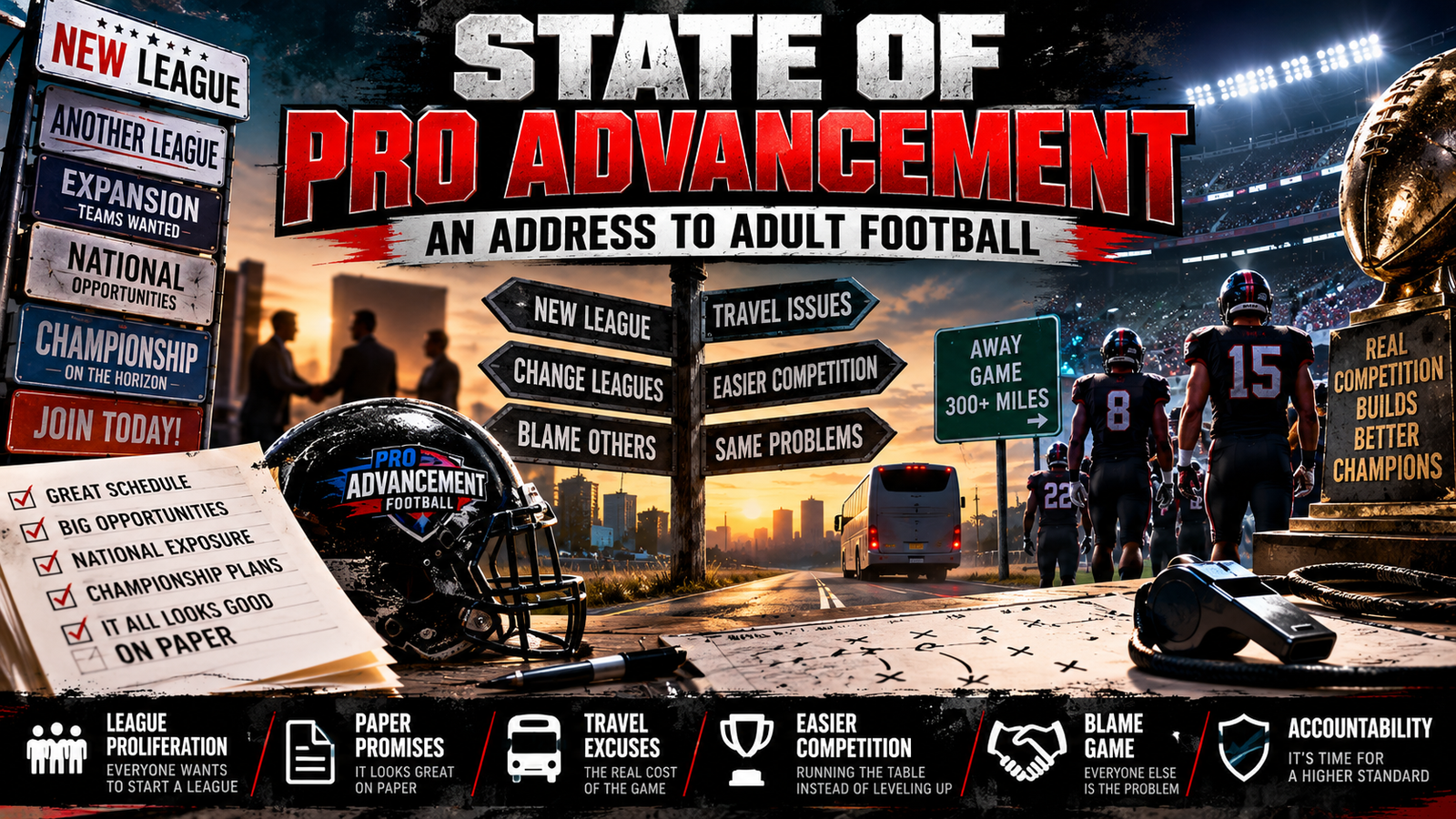
Opinion | League Accountability, Competitive Integrity and the Future of Adult Football
Everybody Wants Respect. Not Everybody Wants Accountability.
There is a conversation that needs to happen across adult football, and it has nothing to do with who has the biggest roster, the loudest fan base or the most impressive record.
It is about accountability, credibility and the direction of the game itself.
Every season, teams change leagues, new organizations announce ambitious plans, travel complaints become public disputes, and disagreements turn into blame games. Meanwhile, some organizations appear more interested in collecting affiliations and championship claims than building stable, competitive football programs.
Some leagues promise the world before their first kickoff. Some teams leave one organization and insist the previous league was the entire problem. Others seek out competition they can dominate rather than testing themselves against comparable opponents.
Some leagues appear eager to announce another member without asking whether that organization is a good fit, has addressed its previous problems or can meet the new league’s expectations.
And there are owners who believe starting a team is as simple as recruiting players, collecting fees and figuring out the rest later.
If the goal is to grow adult football, these are conversations we cannot keep avoiding.
Everybody and Their Brother Wants to Start a League
It can sometimes feel like everybody and their brother wants to start a football league.
A new name appears. A logo gets unveiled. A website promises a better experience. Social media fills with announcements about expansion, national opportunities, championship events and a new direction for the sport.
On paper, everything looks fantastic.
The vision is ambitious. The competition sounds exciting. The plans promise to solve the problems that other leagues supposedly could not fix.
But a logo is not a league. A website is not an operating structure. A championship graphic is not proof that an organization can successfully run a season.
Starting a league is easy to announce. Building one that consistently delivers is the real test.
Running a legitimate competition requires dependable leadership, clear rules, qualified officials, financial planning, realistic geographic boundaries, reliable communication and a process for handling disputes.
It also requires the willingness to make difficult decisions when a member organization fails to meet its commitments.
Before launching another league, organizers should ask whether they have the resources, leadership and structure to deliver what they are promising. They should consider scheduling, travel, officiating, insurance, disciplinary procedures and the financial realities facing their members.
The adult football landscape does not need another collection of promises. It needs organizations that can demonstrate they are prepared to do the work.
Everybody Is an Expert Until the Bills Come Due
There is another uncomfortable reality in adult football: the number of people who believe starting a team or operating a league is easy, inexpensive and something they can figure out as they go.
Someone wakes up one day, decides they want to own a football team, recruits a few players, creates a logo, opens a social media page and starts collecting player fees. Suddenly, they are an owner.
But what happens after the announcement?
Where is the business plan? Where is the financial backing? What happens when player payments come in late, a sponsor falls through, equipment needs replacing or an unexpected expense hits the organization? What happens when a game is canceled, a field becomes unavailable or the team needs to travel farther than originally budgeted?
Those questions should be answered before a team takes the field, not after the money runs short.
There is nothing wrong with starting small. Many successful organizations begin with limited resources, dedicated volunteers and a genuine passion for the game. Not every team needs wealthy ownership or a major financial investor to get started.
But there is a difference between starting modestly with a realistic plan and starting without a plan at all.
Passion can start a football organization. Passion alone cannot guarantee that it will remain operational.
A responsible owner should understand the costs of operating a team, establish a realistic budget, identify reliable sources of funding and have a contingency plan for unexpected expenses. Player fees may be part of that budget, but they should not be treated as a magic solution to every financial problem.
If the entire operation depends on collecting enough money from players to cover the next bill, the organization needs to be honest about its financial vulnerability.
Players are not simply customers purchasing a spot on a roster. They are people investing their time, money and trust in an organization that has made commitments to them.
They deserve to know that the team has a reasonable plan for providing the season, facilities, equipment and competition they were promised.
Running a League Is Not as Cheap as Some People Claim
The same principle applies to league operators.
Every so often, someone presents the idea that running a football league does not cost very much. The argument often sounds simple: recruit teams, have them pay their fees, create a schedule and let the games happen.
If only it were that easy.
A league’s actual operating costs depend on its size, geographic footprint, competition format and services. But there are real expenses and responsibilities that cannot simply be wished away.
Scheduling and administration require time and resources. Officials must be coordinated and compensated according to the league’s arrangements. Fields and facilities may need to be secured. Insurance requirements must be addressed. Rules must be written and enforced. Disputes need a process for resolution. Communication systems, recordkeeping, standings, playoff arrangements and championship events all require organization.
Travel creates additional challenges when teams are spread across a large region. Last-minute schedule changes can create costs and logistical headaches for multiple organizations. Disciplinary problems can consume time and resources that should have been devoted to developing the competition.
Even when volunteers perform much of the work, that work still has value. Volunteer labor does not eliminate the need for a functioning operating plan.
Some leagues can keep costs low through volunteer administration, donated facilities, sponsorships and efficient operations. Others may have greater financial resources or different revenue arrangements. There is no single budget that fits every league.
The issue is not whether an organization spends a lot or a little.
The issue is whether its leadership understands what the operation requires and has a credible plan to meet those requirements.
Player Fees Are Not a Business Plan
One of the biggest warning signs is an organization whose financial strategy begins and ends with collecting money from its teams or players.
Membership fees and player fees can be legitimate sources of revenue. The problem comes when leadership assumes those payments will always be sufficient, arrive on time and cover every expense.
What happens when a team withdraws? What happens when several players cannot pay? What happens when an unexpected cost exceeds the amount collected? What happens if the league expands faster than its financial resources can support?
Those are not unreasonable questions. They are basic planning questions.
A sustainable organization should understand its projected income, operating expenses, financial obligations and risks before making commitments. It should know which costs are fixed, which vary with participation and what resources are available if revenue falls short.
That does not require every adult football organization to operate like a major professional franchise. It requires leadership to understand the difference between revenue and profit, between a budget and a wish list, and between having enough money to launch a season and having enough support to finish it.
Collecting fees is easy to describe. Managing an organization responsibly is the harder job.
The Experts Who Have All the Answers
There is also no shortage of people willing to explain how everyone else should run football.
They know exactly what is wrong with other leagues. They know how schedules should be built, how teams should be recruited and how championships should be organized. They can point to every mistake another organization has made.
Then they decide to launch their own operation.
Suddenly, the supposedly simple business of running a league becomes much more complicated.
The schedule requires more work than expected. Teams have conflicting needs. Travel becomes an issue. Officials must be coordinated. Money becomes tight. Members disagree about rules and decisions. The promises made during recruitment become harder to deliver.
That is when the difference between talking about running a league and actually running one becomes clear.
Criticism is easy when someone else is responsible for the outcome. Leadership means accepting responsibility when the decisions are yours.
Anyone can say they would do things better. The real test is whether they can establish a workable structure, communicate honestly, manage their resources and deliver a reliable competition over an entire season.
If you believe the existing model is broken, demonstrate a better one. Build a realistic plan, establish clear standards, understand the costs and show teams what they can expect.
Do not confuse confidence with preparation or a convincing sales pitch with operational experience.
Growth Without a Foundation Can Become a Liability
Expansion is attractive. More teams mean more potential matchups, a broader geographic reach and additional opportunities for players.
But expansion also creates additional responsibilities.
A league that recruits more teams than it can reasonably support may discover that its growth has outpaced its infrastructure. More members can mean more scheduling conflicts, more administrative work, more travel coordination and greater demands on leadership.
The same is true for team owners. Adding players, entering another competition or promising a larger schedule does not automatically make an organization stronger.
Growth should follow the development of the resources needed to support it, not replace that development.
Before announcing another team or another league, leadership should be able to explain how the organization will operate, what it will cost, where its resources will come from and how it will respond when circumstances change.
The goal should be to build something that lasts, not something that looks impressive for a few weeks.
Everything Looks Good on Paper
A league can advertise an impressive membership list, a national footprint and a clear path to a championship. But until those plans are tested, they remain plans.
Teams withdraw. Schedules change. Travel becomes more expensive than anticipated. Officials become difficult to secure. Leadership disagreements emerge. Financial expectations collide with reality.
None of those challenges automatically makes a league illegitimate. Every organization faces obstacles. The difference is how those challenges are managed.
Does leadership communicate honestly when plans change? Are teams given realistic expectations? Are rules enforced consistently? Does the league accept responsibility when it makes a mistake?
Teams must do their homework before joining, too. They should review the rules, understand the travel requirements, ask about financial obligations and determine how disputes are handled.
A league should ultimately be judged by the competition it produces, the commitments it honors and the way it treats its members, not simply by the way it markets itself.
Are Leagues Recruiting Teams or Collecting Names?
This is where the conversation gets uncomfortable.
A league announces another member. The announcement gets promoted across social media. The membership list grows, the footprint looks bigger, and supporters are told the organization is becoming stronger.
But what does that addition actually mean?
Did the league evaluate the team’s previous season? Did it examine the organization’s ability to meet its commitments? Did it consider documented conduct issues, unresolved obligations or repeated scheduling problems? Did it determine whether the team fits the league’s competitive structure?
Or was the priority simply getting another name on the membership graphic?
There is a meaningful difference between recruiting an organization because it strengthens the competition and accepting one primarily because the announcement looks impressive.
Membership should involve an honest evaluation, not simply a desire to make a rival league look smaller.
That does not mean a team with a difficult history should automatically be rejected. Organizations can learn, leadership can change, and disputes can involve more than one side. A prospective member deserves a fair opportunity to explain its circumstances.
But responsible league leadership should ask questions, examine documented information and establish expectations before extending an invitation.
A league that ignores everything that happened during the previous season because it wants another member may be transferring unresolved problems into its own organization.
That is not necessarily growth. Sometimes it is simply relocating a problem.
Free Membership, Big Promises and the Question Nobody Asks
One of the most attractive selling points a league or football organization can offer is simple: no league fees, no membership costs or no additional financial burden.
For teams operating on tight budgets, that can be a legitimate advantage. Every dollar saved can help with uniforms, equipment, transportation, field rental and other operating expenses.
There is nothing inherently wrong with a league offering free membership. There is also nothing wrong with an organization looking for affordable opportunities.
But a team should look beyond the price tag.
What exactly is included? Who handles scheduling? Who enforces the rules? What happens when a team refuses to honor a commitment? Is there a written code of conduct? Are disciplinary procedures documented? Is there a process for resolving disputes? Who is responsible when a game falls apart or a member organization creates a problem?
Most importantly, what structure exists to ensure the competition operates as promised?
A free membership that provides meaningful support, transparent governance and reliable competition may be an excellent opportunity. A free membership with unclear responsibilities, inconsistent enforcement and little accountability may create a very different experience.
The same questions apply to organizations promising national exposure, championship opportunities, major partnerships or an easier path to success.
Those benefits should be evaluated by what is actually delivered, not simply what appears in a promotional announcement.
The question is not whether a league charges fees. The question is whether it provides the structure, leadership and accountability needed to make membership worthwhile.
Teams should ask those questions before signing up, and leagues should be prepared to answer them clearly.
Are Leagues Taking Teams Just to Make a Statement?
Competition between leagues is natural. Organizations compete for teams, players, recognition and supporters. That competition can encourage leagues to improve their operations.
But what happens when attracting another league’s members becomes a public-relations exercise?
Imagine a league accepting an organization primarily because it previously belonged to a rival. The addition is announced as a major victory. The new member is presented as proof that the recruiting league is stronger, while the former league is portrayed as having lost something important.
Now imagine that the incoming organization had documented disciplinary problems, unresolved commitments or a difficult previous season. Were those issues evaluated? Were expectations established? Or did the desire to claim another member outweigh the need for due diligence?
Those are fair questions.
A league should not automatically assume a team is a problem simply because it left another organization. But it should not automatically assume the team is a prize simply because it came from a competitor, either.
If the primary motivation is to take teams away from another league and pound your chest about it, what has actually been accomplished?
Did the new league improve its schedule? Did it strengthen competitive balance? Did it gain a dependable member that will honor its commitments? Or did it simply acquire another name for a graphic?
A league’s strength should be measured by the quality and stability of the competition it builds, not by how loudly it celebrates taking members from somebody else.
If an organization genuinely believes in its own product, it should demonstrate that through reliable schedules, fair governance, meaningful matchups and consistent treatment of its members.
It should not need to turn every recruiting decision into a public contest with another league.
Previous Behavior Should Matter, but So Should Fairness
When a team changes leagues, the new organization should understand the circumstances surrounding that move.
Was the departure caused by legitimate differences over geography, finances, scheduling or league direction? Did the previous organization fail to meet its own obligations? Were there documented disciplinary issues? Did the team leave in good standing?
Those questions deserve consideration.
If a team was removed from a previous league following documented disciplinary problems, that history should not automatically disappear when it applies for membership elsewhere.
The new league should examine the facts, allow the organization to respond and determine whether any concerns are relevant to its own standards.
That is due diligence, not a campaign to blacklist teams.
No organization should be condemned based solely on rumors, social media arguments or the statements of a former league. But fairness does not mean ignoring documented history because adding another member makes the league look bigger.
If a league has membership requirements and a code of conduct, it should apply them consistently. A prospective member should face the same meaningful evaluation regardless of its name, reputation, record or previous affiliation.
Otherwise, a league risks creating one standard for teams it wants to recruit and another for everyone else.
Travel Is a Real Issue. So Is Keeping Your Commitment.
Travel is one of the most common challenges in adult football, and it deserves a fair discussion.
Players have jobs, families and financial responsibilities. Teams operate with limited budgets. Fuel, lodging, meals and time away from home can make a long-distance schedule difficult to sustain.
Those concerns are legitimate.
But teams should evaluate a league’s geographic footprint and travel expectations before committing to membership.
If the schedule requires several long road trips, that should be considered during the decision-making process. If circumstances change, organizations should communicate their concerns early and work toward reasonable solutions whenever possible.
A league also has a responsibility to establish realistic geographic boundaries and avoid promising a schedule its members cannot reasonably support.
What does not work is accepting membership, enjoying the opportunities it provides and then treating the obligations as optional when they become inconvenient.
If the arrangement no longer works, a professional departure may be the right decision. But there is a difference between making a difficult organizational choice and repeatedly expecting everyone else to absorb the consequences of your own planning.
League Hopping Does Not Automatically Solve Anything
There is nothing inherently wrong with changing leagues.
An organization may find a better geographic fit, a more suitable level of competition or a structure that better matches its budget and goals.
The concern is the pattern that emerges when every disagreement becomes a reason to leave.
A dispute develops. A rule is enforced. A schedule creates frustration. Leadership relationships deteriorate. Before long, the organization is looking for a new home and explaining why the previous league was responsible for the problems.
Sometimes that criticism is justified. League leadership is not infallible, and teams deserve fair treatment, transparent rules and an opportunity to challenge decisions.
But switching leagues does not automatically establish that the departing team was right. Nor does it prove the previous league was wrong.
If a team leaves following documented disciplinary issues or unresolved commitments, those circumstances should be evaluated fairly rather than erased by a new affiliation.
A new league should provide a fresh opportunity to compete, not an automatic clean slate for organizational conduct.
The best way to demonstrate that a previous relationship was the problem is to build a better one in the next league.
That requires more than a new logo on the uniform. It requires a different approach to communication, responsibility and commitment when those are the areas that previously broke down.
Are Some Teams Choosing the Easiest Road to a Championship?
Another uncomfortable issue in adult football is the temptation to compete below an organization’s demonstrated level simply to dominate the field.
There is a difference between finding the right competitive fit and deliberately seeking the weakest available opposition.
Not every team with a strong record is playing below its level. Rosters change, organizations rebuild and leagues have different standards. A dominant season does not automatically prove that a team belongs somewhere else.
But the question deserves to be asked when an established organization consistently chooses competition that appears significantly below its capabilities, particularly when stronger challenges are available.
Is the goal to develop players, build a sustainable program and prepare for tougher competition? Or is it to collect wins, advertise an impressive record and celebrate championships without facing the level of opposition that would truly test the team?
There is nothing wrong with winning. Winning is the objective of competition.
But if a powerhouse organization has struggled against strong opposition, then moves into a competition where it expects to dominate, the question becomes whether the move is about development or simply producing a more attractive record.
An undefeated season looks impressive. A championship trophy looks impressive. Neither tells the entire story without context about the competition faced.
A team that overwhelms substantially weaker opposition may be operating within its league’s rules, but its record alone does not establish that it has improved or proven itself against stronger competition.
Competitive classifications should have a purpose. Organizations should be willing to evaluate whether their teams belong in the divisions in which they compete.
Moving up should not be treated as punishment for success. It can be an opportunity to test an organization, develop players and improve the quality of competition.
If the goal is to prove how good your team is, eventually you have to be willing to play teams capable of challenging you.
The Blame Game Never Builds a Better Organization
When a relationship between a team and a league breaks down, public statements often follow.
One side tells its version of the story. The other responds. Social media becomes the courtroom, and supporters decide who is right before all the facts are available.
Sometimes a league makes a bad decision. Sometimes a team is treated unfairly. Sometimes both sides contribute to a dispute.
The responsible approach is to examine the evidence.
What rules applied? Were they communicated clearly? Was the process followed? Were similar cases handled consistently? Did the organization meet its commitments? Was there an opportunity to appeal or resolve the matter?
Those questions matter more than whichever side produces the loudest statement.
Teams should be able to challenge unfair treatment without automatically being labeled troublemakers. Leagues should be able to enforce their rules without every disciplinary decision becoming a public referendum on their legitimacy.
If a league makes a mistake, it should own it. If a team makes a mistake, it should own that, too.
The blame game may rally supporters for a few days. It rarely fixes the underlying problem.
Championships Should Mean Something
Adult football championships matter to the players, coaches and supporters who invest their time and money.
But leagues have a responsibility to establish credible divisions, meaningful schedules and consistent membership standards.
When teams are mismatched, competition suffers. Players lose opportunities to develop through challenging games, fans lose compelling matchups, and the credibility of the league can take a hit.
A strong league should want its best teams to face appropriate challenges. It should also provide a pathway for developing organizations to improve without being overwhelmed before they are ready.
The goal should be to create competition in which championships are earned, divisions make sense and teams understand what success requires at each level.
A league that wants to be respected must be willing to evaluate its own structure, not simply celebrate whichever team finishes undefeated.
Football Is a Partnership, Not a Personal Favor
A football league is not simply a scheduling service designed to accommodate every preference of every member.
It is a shared structure. Teams depend on one another to honor schedules, follow rules, communicate changes and create a competition that supporters can trust.
League leadership has obligations to its members. Teams have obligations to the league and to one another.
When an organization repeatedly places its own convenience above those shared responsibilities, the consequences spread beyond its front office. Opponents face uncertainty. Players may lose opportunities to compete. Travel arrangements and budgets can be disrupted. League officials spend time managing avoidable conflicts instead of developing the competition.
Winning games does not excuse poor organizational conduct. A large following does not excuse it. Neither does a recognizable name, an impressive record or a championship trophy.
The same standards should apply to everyone.
The Standard Adult Football Needs
The adult football landscape does not need every league to operate identically. Different organizations will have different philosophies, geographic footprints, financial structures and competitive goals.
New leagues can be valuable. Free membership can be beneficial. Teams should be free to explore better opportunities, and league leadership should be free to establish standards that reflect its mission.
But new organizations must prove they can deliver what they promise. Team owners must understand the commitments they accept. Travel concerns should be handled honestly. Disputes should be addressed through fair procedures. Competitive classifications should promote meaningful matchups.
Leagues should evaluate prospective members rather than treating every new affiliation as a victory over a competitor. Teams should examine their own decisions rather than automatically blaming the organizations they leave.
Owners should develop realistic operating plans instead of assuming player fees will solve every financial challenge. League leaders should understand the actual cost of running a competition before telling everyone how inexpensive the process should be.
And organizations with powerhouse rosters should be willing to demonstrate their strength against appropriate competition rather than measuring success only by how many opponents they can overwhelm.
The game is bigger than any one team, league or executive.
Players, coaches, officials, volunteers and supporters deserve organizations that respect their time, honor their commitments and take responsibility when things go wrong.
No league is perfect. No team is perfect. Mistakes happen, relationships end and new opportunities emerge.
But if adult football wants to grow, it needs fewer promises that look impressive on paper and more organizations that deliver in practice.
It needs fewer excuses and more accountability.
It needs leagues that recruit responsibly, owners who plan financially, teams that compete at appropriate levels, and leaders who understand that membership numbers mean very little if the underlying competition is unstable.
If you want respect, earn it. If you want a championship, compete for it. If you want a fresh start, begin by taking responsibility for your own organization. And if you want to prove your league is stronger than the competition, build something that proves it on the field and through the way you operate.